
Mechanical Aquatic Weed Harvesting in California: Cost, Process & Benefits
Mar 19, 2026
When aquatic weeds take over a California lake, pond, or waterway, property owners and managers face a choice: treat with chemicals, attempt manual removal, or deploy professional mechanical harvesting equipment. Each approach has its place, but for medium-to-large water bodies with established weed growth, mechanical aquatic weed harvesting has emerged as the most effective, environmentally responsible, and long-term-viable option available.
In this guide, we explain exactly how mechanical harvesting works, what it costs in California, what to expect during and after a project, and why it's becoming the method of choice for municipalities, HOAs, golf courses, and private landowners throughout the state.
What Is Mechanical Aquatic Weed Harvesting?
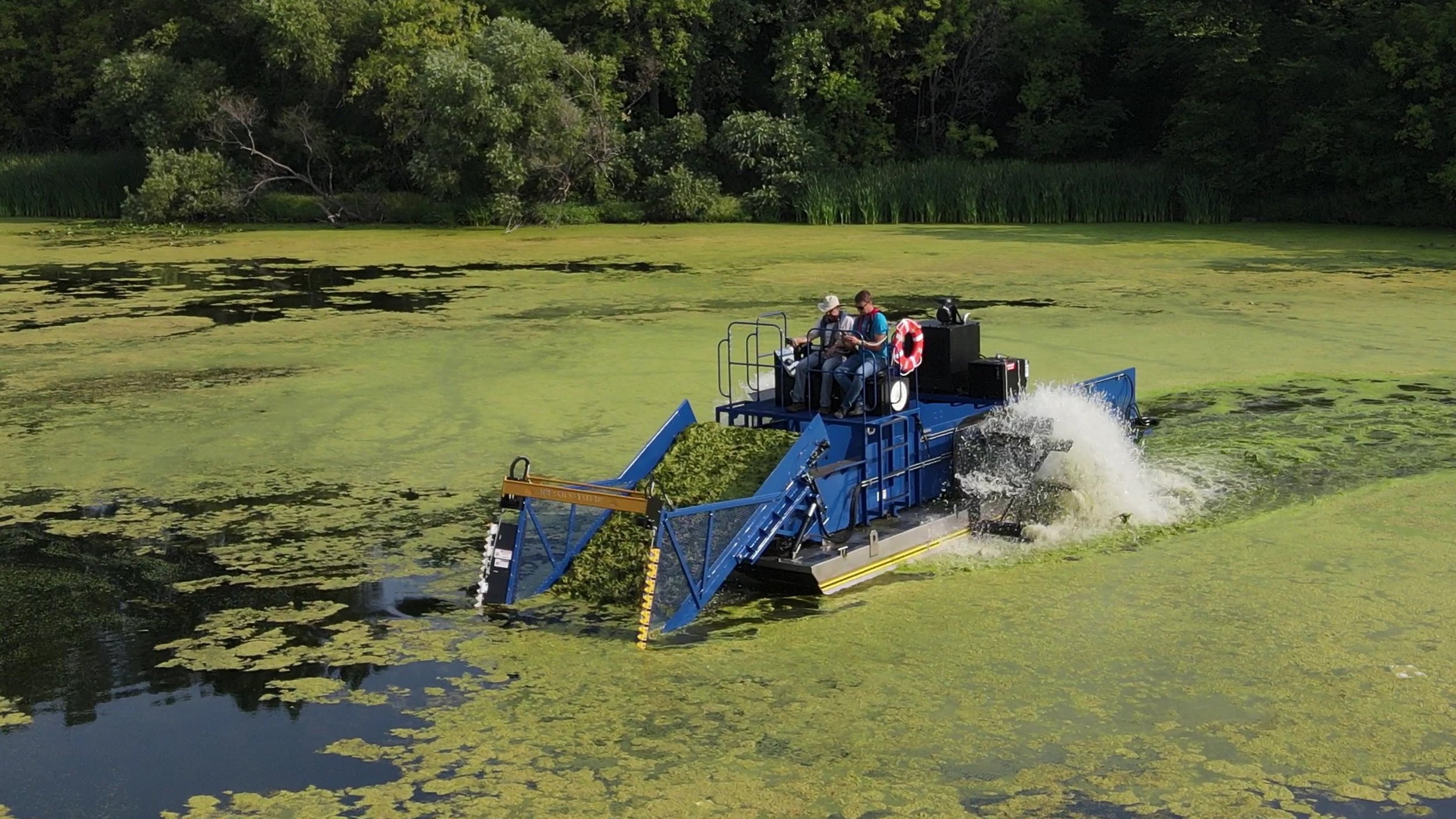
Mechanical aquatic weed harvesting is the process of physically cutting, collecting, and removing aquatic vegetation from a lake, pond, or waterway using specialized floating equipment—aquatic harvester boats—equipped with underwater cutting blades, conveyor systems, and onboard storage.
This is not the same as weed cutting or mowing. True mechanical harvesting removes the plant material entirely from the water body. The harvested vegetation is conveyed onboard, transported to shore, offloaded, allowed to dewater, and then hauled away for composting, disposal, or other end-use. The distinction matters enormously: cutting without removal leaves decomposing plant matter in the water, which releases nutrients back into the water column and feeds the next generation of weeds and algae.
The Mechanical Harvesting Process: Step by Step
Understanding what actually happens during a professional mechanical harvesting project helps lake managers set realistic expectations and prepare their properties appropriately.
Step 1: Pre-Project Assessment
Before any equipment enters the water, a qualified aquatic manager surveys the lake to assess:
Species identification: What plants are present? Different species require different harvesting techniques. Surface canopy plants like water hyacinth are harvested differently than submerged species like Eurasian watermilfoil.
Coverage and density mapping: How much area is affected and how deeply is vegetation growing?
Access and logistics: Where can equipment enter the water, and where will harvested material be offloaded?
Water depth and bottom conditions: Harvest boats have minimum depth requirements (typically at least 18 inches) and can be damaged by submerged obstacles.
Regulatory considerations: Are there any permits required? Are there active fish surveys that would restrict timing? In California, certain waterways require notification or permits before mechanical operations.
Step 2: Equipment Deployment
Professional aquatic harvest boats are sophisticated floating machines. The front of the harvester contains a cutting mechanism—typically horizontal and vertical sickle-bar cutters—that can be raised, lowered, and set to a specific cutting depth (usually from the surface down to approximately 5–6 feet). This depth control allows operators to cut vegetation at the lake bottom, just above the substrate, which slows regrowth and maximizes effectiveness.
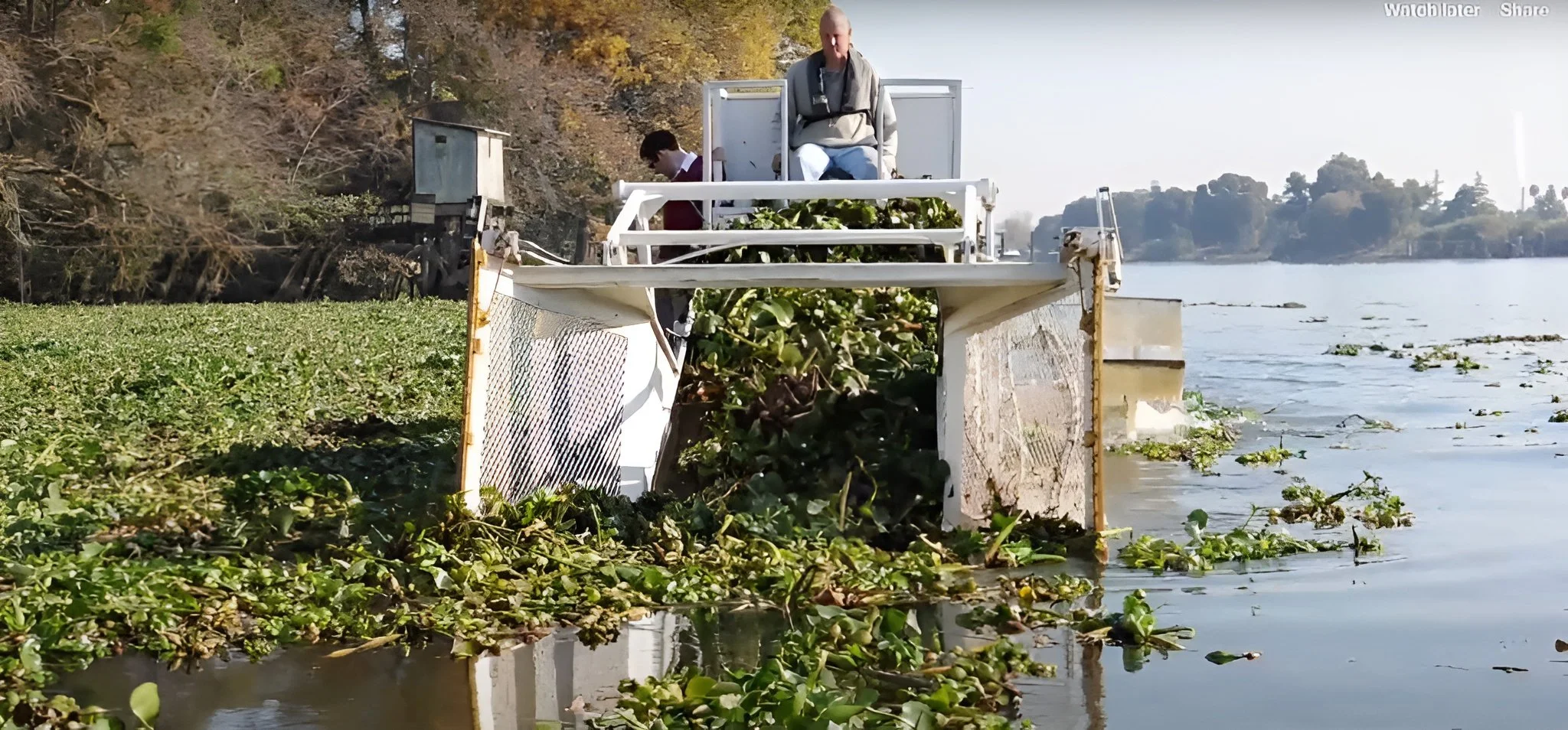
As the harvester moves through the water, cut plants are lifted onto steel conveyor mesh and transported to an onboard holding area beneath the operator's platform. Pontoons on either side of the boat keep it stable even when loaded with hundreds of pounds of wet, waterlogged plant material.
Step 3: Active Harvesting
Harvesting proceeds systematically across the treatment area. GPS guidance systems, now standard on most professional harvesters, ensure complete coverage and allow crews to generate detailed reports showing exactly which areas were treated and how much acreage was cleared.
Work proceeds in passes across the weed growth, with regular offloads to shore when the vessel's holding area reaches capacity. In densely vegetated areas, a single pass may need to be followed by additional passes to achieve target clearance.
Step 4: Biomass Offload and Disposal
At regular intervals, the harvest boat returns to a designated shore transfer site and offloads the collected plant material. Modern harvesters use a rear conveyor system for efficient discharge.
Once onshore, the vegetation pile dehydrates rapidly. A pile of freshly harvested aquatic weeds can be 80–90% water by weight, meaning a significant portion of apparent volume is lost as it dries. After dewatering, the material is loaded into trucks for haul-off.
Depending on location, local regulations, and the species harvested, the collected vegetation may be composted, used as agricultural soil amendment, or disposed of at a licensed facility.
Step 5: Post-Harvest Monitoring and Follow-Up
Mechanical harvesting provides immediate visible results, but most aquatic plants will regrow within weeks to months, particularly in California's warm climate. Post-harvest monitoring allows the management team to track regrowth rates and schedule follow-up harvests before vegetation re-establishes at nuisance levels.
Typically, one to two harvests per season provide good season-long control for most target species. More aggressive infestations or fast-growing species like water hyacinth may require more frequent attention.
What Does Mechanical Harvesting Cost in California?
Cost is naturally one of the first questions lake managers ask. The honest answer: it varies significantly based on several factors. Here's a realistic framework for understanding the cost structure.
Factors That Affect Cost
Lake size and vegetation coverage: Harvesting costs are often priced by the acre, by the hour, or as a project-based estimate. Larger areas obviously require more equipment time and more haul-off loads.
Vegetation type and density: Dense mats of heavy, wet vegetation like water hyacinth take significantly more time to harvest per acre than lighter submerged vegetation. Harvesting projects can yield 8–15 tons of wet vegetation biomass per acre — that's a lot of material to manage.
Site access and logistics: Easy access to the water, a good shore transfer site close to the treatment area, and a short haul to a disposal site all reduce costs. Remote or constrained access points add time and cost.
Frequency of service: Annual maintenance contracts generally provide better per-visit value than one-time emergency harvesting projects.
California context: Industry data shows that single chemical applications for California lakes can run above $15,000 — and the U.S. Bureau of Reclamation spent nearly $1 million annually during peak drought years managing aquatic weeds at a single California facility. Mechanical harvesting, priced against this context, often delivers competitive cost-effectiveness with the added advantage of complete biomass removal.
General Cost Range
For professional mechanical harvesting services in California, project costs commonly range from $3,000 to $12,000+ per treatment, depending on treatment area size, vegetation type, accessibility, and distance to disposal sites. For ongoing annual lake management programs that include harvesting as a component, per-treatment costs are typically lower within a service contract.
We strongly recommend requesting a site-specific assessment and quote rather than estimating from generic figures. The variables that affect cost are significant, and a proper site visit allows our team to give you an accurate, honest number.
The Benefits of Mechanical Harvesting Over Chemical Treatment
For many California lakes and the managers responsible for them, mechanical harvesting offers meaningful advantages compared to herbicide-only programs.
No Water Use Restrictions
Chemical aquatic treatments typically require a waiting period before the treated water can be used for irrigation, livestock watering, or swimming. These restrictions can range from 24 hours to 2 weeks depending on the chemical used and the intended water use. For HOA lakes, golf courses, or properties where water is actively used, these restrictions are operationally disruptive.
Mechanical harvesting has no water use restrictions. Water is safe for all uses immediately after harvesting is complete.
Complete Nutrient Removal
This is one of the most ecologically significant advantages of mechanical harvesting. When you physically remove aquatic vegetation and haul it off-site, you're removing all the phosphorus and nitrogen that was locked in that plant biomass. Those nutrients cannot recycle back into the water column to fuel the next weed or algae bloom.
Chemical treatments kill vegetation, but the decomposing plant matter left in the lake returns nutrients to the water, which is why lakes treated only with herbicides often see rapid regrowth and continuing bloom cycles.
Targeted and Selective
Mechanical harvesting equipment gives operators precise control over which areas are treated and at what depth. This allows management teams to:
Clear swimming areas, boat launches, and navigational channels while leaving beneficial habitat vegetation in other areas
Protect shallow nursery habitat for fish while clearing deeper growth areas
Avoid sensitive shoreline features
Immediate, Visible Results
Chemical treatments take time to work — days to weeks for herbicides to kill target vegetation. Mechanical harvesting delivers immediate, visible results. Boating channels open on the day of harvest. Swimming areas clear within hours. This matters enormously for HOA communities, public lake managers, and golf courses where a clear, attractive water body is expected.
Regulatory Advantages
Applying aquatic chemicals in California requires licensed applicators, sometimes requires notification of adjoining property owners, and in some waterways requires state or federal permits. Mechanical harvesting avoids most of this regulatory overhead, making it simpler to deploy quickly when weed problems emerge.

Is Mechanical Harvesting Right for Your Lake?
Mechanical harvesting is not the right tool for every situation. Here's a quick guide:
Best suited for:
Established weed growth over more than about 20–25% of a water body's surface
Water hyacinth, giant salvinia, and other floating canopy plants
Dense submerged vegetation that has reached the surface (milfoil, Egeria, hydrilla)
Cattails and emergent vegetation along shorelines (with appropriate equipment)
Any situation where water use restrictions from chemicals would be problematic
Water bodies where ongoing chemical permitting is burdensome
May not be the primary tool for:
Very shallow areas less than 18 inches deep
Fragmentation-prone submerged plants (Egeria, milfoil) in flowing water where fragments could spread downstream without containment
Sparse early-stage infestations where chemical spot treatment may be more efficient
Water bodies with extensive submerged obstacle fields (stumps, debris)
The best outcomes consistently come from integrated management programs that use mechanical harvesting alongside other tools — aeration systems, targeted chemical treatments, biological amendments, and nutrient management — tailored to the specific characteristics of each water body.
Aquatic Harvesting: California's Mechanical Harvesting Specialists
Aquatic Harvesting operates professional-grade aquatic harvest boats and Aquatic Vegetation Cutter (AVC) equipment throughout California and the western United States. We provide mechanical aquatic weed harvesting for municipalities, HOA communities, private landowners, corporate campuses, golf courses, and agricultural water managers.
Our services include initial site assessment, full harvesting operations, biomass disposal coordination, and follow-up monitoring—all delivered by trained, experienced crews who understand California's unique regulatory environment.
